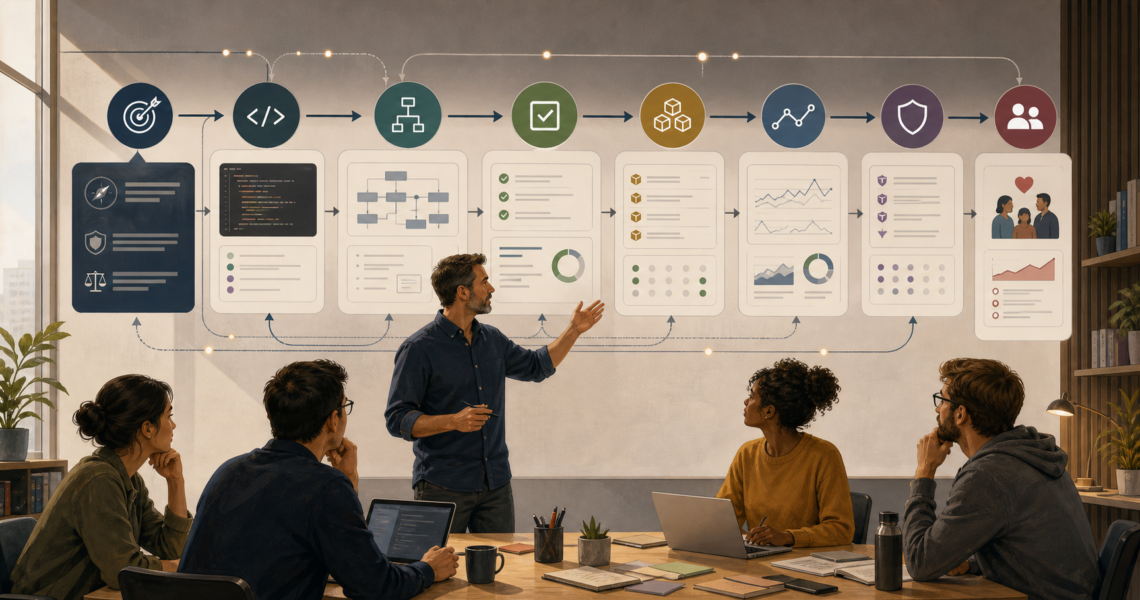
How The AI-Native Approach Is Changing Software Delivery
Over the last six months, software delivery has started to feel different.
The shift is not only about individual developers getting help from coding assistants and agents. The bigger change is that software delivery is moving to a higher level of abstraction. Engineers are communicating intent, teams are codifying standards into reusable AI skills, and delivery workflows are starting to connect source code, tickets, documents, pipelines, logs, and production systems.
By AI-native software delivery, I mean a delivery model where AI is not only assisting individual coding tasks, but participating across the delivery system: intent, standards, workflows, tools, reviews, operations, and decision-making.
I have seen this shift most clearly when teams stop asking, “Can AI write this code?” and start asking, “Can AI help us move this workflow end to end?”
Let’s explore some of the recent shifts I am seeing across software delivery.
This article covers:
- Copilot to intent
- Connected ecosystems
- AI skills
- Custom tools
- Architecture
- Bootstrapping, migrations, and tech debt
- Co-contribution
- Security remediation
- Production operations
- New AI-native engineers
- Visibility of bottlenecks
Copilot To Intent
The first wave of AI-assisted development was mostly autocomplete and code suggestions. Useful, but still limited. The engineer remained responsible for every small movement.
The AI-native approach is different.
The engineer spends more time defining the intent, outcome, constraints, standards, tests, guardrails, and acceptance criteria. The coding agent then does more of the heavy lifting.
This does not reduce the need for engineering judgement. It increases it. The value moves from typing every step to directing the work clearly, reviewing trade-offs, and deciding whether the result is good enough for production.
In the old model, productivity came from how fast you could implement.
In the new model, productivity increasingly comes from how well you can direct.
Connected Ecosystems
Software delivery never lived only in the codebase. It lives across source control, ticketing, wiki, messaging, build systems, deployment tools, logging, monitoring, incident management, and security platforms.
Historically, engineers manually stitched this context together.
AI-native delivery changes that. When agents can connect to these systems, teams can ask better questions:
- What changed between the last successful build and this failure?
- Which service owns this error?
- Which ticket, design decision, or deployment is related?
- What tests or documentation are missing?
The productivity gain becomes more than coding speed. It becomes coordination speed.
AI Skills
One of the most important shifts is the rise of AI skills: reusable instructions, workflows, standards, and operating knowledge that an AI agent can apply repeatedly.
Many of these can be simple Markdown files written in natural language:
- how we write tests
- how we review API changes
- how we investigate incidents
- how we prepare release notes
- how we assess architecture trade-offs
- how we write migration plans
This turns team knowledge into executable guidance.
Instead of repeating the same explanation in every review, teams can start saying:
- “Let’s build a skill for this.”
- “Let’s update the skill.”
- “This should be part of our migration skill.”
- “Can we compose this with the existing release-readiness skill?”
This is how team standards become easier to apply and improve. Over time, smaller skills will combine into higher-level workflows.
Custom Tools
AI skills are powerful, but they are not the end of the story. Custom tools are also becoming much easier to build.
For a long time, teams either bought a third-party tool or waited for internal tooling to become a prioritised project. That trade-off is changing.
If a team has a high-friction workflow specific to its context, it can now build a lightweight internal tool much faster: a dashboard, workflow assistant, report generator, pull request analyser, release checklist generator, or incident helper.
The tool does not exist?
That is no longer the end of the conversation.
The risk is tool sprawl, so judgement still matters. But the economics of small, team-specific software are changing quickly.
Architecture
Architecture is always about trade-offs. The right answer depends on organisational context: existing systems, team capability, regulation, cost, time horizon, migration risk, and business urgency.
AI-native delivery helps teams evaluate those trade-offs faster.
Instead of debating from memory or preference, teams can generate multiple options, trade-off tables, migration paths, risk lists, decision records, and working prototypes.
The point is not that AI “does architecture.”
The point is that it makes the reasoning more visible and gives teams more options to compare before making a decision.
Bootstrapping, Migrations, And Tech Debt
Some work used to feel heavy before it even started: bootstrapping a new project, migrating a framework, upgrading a library, converting tests, cleaning up old patterns, or documenting an existing system.
These tasks still require care, but they no longer feel like the same kind of blocker.
An AI-native workflow can inspect the current structure, propose a migration plan, apply the first changes, update tests, generate documentation, highlight risk, and prepare a pull request summary.
Not all tech debt disappears. But some categories become easier to address because the repetitive work is less expensive.
Co-Contribution
Many delivery delays come from dependencies on other teams.
A team needs a library change, platform update, API enhancement, or small fix in another codebase. The owning team agrees it is useful, but they have their own backlog and priorities.
AI-native development makes co-contribution more practical. A consuming team can understand the target codebase faster, follow local standards, generate tests, prepare documentation, and reduce review effort for the owning team.
The conversation shifts from:
Can your team prioritise this for us?
to:
We have a valid use case, a tested change, and a pull request ready for review.
That is a healthier model.
Security Remediation
Security remediation often takes a meaningful portion of development time: dependency fixes, vulnerability remediation, policy checks, insecure pattern fixes, and compliance follow-up.
AI-native delivery will not remove the need for security. It will move remediation closer to the work.
Many remediation steps can be suggested or prepared automatically: dependency upgrades, vulnerable package replacements, policy fixes, insecure pattern detection, missing checks, or misconfigured infrastructure.
The development team may receive a notification with a proposed fix, test impact, and pull request ready to review.
That is very different from waiting for a scan, creating a ticket, scheduling the work, and manually discovering the fix.
Compliance may still remain a human approval and governance bottleneck. But the remediation work around compliance can become much faster.
Production Operations
AI-native delivery is not only about pre-production work. Production operations may change even more.
During a critical incident, the hard part is often connecting the data:
- What changed recently?
- Which service is failing?
- What do the logs show?
- Which deployment introduced the behaviour?
- Is this a known failure mode?
- What mitigation worked before?
An AI-native incident workflow can pull from alerts, logs, dashboards, deployment history, source code, tickets, and prior incidents.
The goal is not to replace incident commanders. The goal is to reduce time lost in context gathering so humans can focus on judgement, communication, mitigation, and customer impact.
New AI-Native Engineers
New engineers entering the industry now will be AI-native from day one.
They may have less experience, but they also have less to unlearn. They will expect to communicate intent, generate options, ask agents to inspect code, build small tools, and automate repetitive work.
Experienced engineers still have a major advantage: judgement, architecture sense, operational awareness, and business context. But experience can also create drag when it turns into scepticism or attachment to old workflows.
The best teams will combine both: experienced engineers who know what good looks like, newer engineers who discover faster patterns without fear, and shared standards that help both groups work together.
This is not a junior-versus-senior shift. It is a learning-speed shift.
Visibility Of Bottlenecks
There is no doubt that individual and engineering-team productivity is improving.
But when engineering gets faster, the real bottlenecks become more visible.
Cycle time may not reduce as much as expected, but the composition of cycle time will change. Less time may be spent on implementation. More time may still be trapped in compliance approval, architecture governance, funding decisions, unclear ownership, dependency negotiation, product decision-making, release coordination, or sign-off from a specific person.
This is one of the most important leadership implications of AI-native delivery.
If leaders only measure coding speed, they will miss the point.
The better question is: where does work wait?
What’s Next
AI-native software delivery may become the entry point for a broader AI-native operating model. But the opportunity only matters if teams redesign how work flows, not just add more tools. AI-native delivery can create faster outcomes, but it can also create noise, inconsistent quality, security risk, tool sprawl, and faster production of the wrong things.
The next advantage will go to teams that can combine human judgement, connected context, reusable skills, and custom tooling into a delivery system that learns.
Let’s revisit this article after 3 months and see what changed.

